Tuesday, 4 June 2019

Five Essential Elements of a Successful School Community


While it's true that each school context is unique and comprised of diverse needs, challenges and strengths, I would suggest that there are certain elements that form the foundation of all successful school communities.  These are what I identify as the "non-negotiables".

1. A clear, consistent vision. 

It is impossible to move forward if we don't know where we're going. 

A clear "road map" that provides a community with a sense of direction is essential. Finding a common purpose should be a collaborative process, and ultimately clearly communicating that vision of the future is the next essential step in any change process. In the midst of what what might be perceived to be competing agendas and initiatives, it is important that we are able to identify and articulate a common vision. We need to be able to "connect the dots" for staff and students, giving purpose and focus to individual initiatives under the larger umbrella of that shared vision.

2. Relationships as a foundation. 

Students and staff need to feel connected and cared for.

In her article "If You Want Students to Learn, They Need to Feel They Belong", author Tricia Taylor highlights the importance of relationships in creating a sense of belonging in school communities.

"Cognitive scientists explain that belonging is important because when we belong, we feel safe, and a safe brain is ready to learn. On the other hand, when the amygdala, the part of the brain responsible for regulating stress, feels threatened or is on high alert, information is then blocked from freely entering areas of higher cognitive memory consolidation and storage. A safe brain allows for a growth mindset and better executive function, which means being better able to make mistakes/take academic risks; having a higher level of self-efficacy (more willing to set higher goals, etc.); and practising more self-control, which results in less conflict. We are also better able to persevere and think hard about tasks."  


3. An environment where both students and staff are encouraged to learn and take risks. 

If students are the only ones who are learning, that's a problem.

We need to model the same curiosity and desire to learn that we hope to instil in our students. That means taking the time both individually and as a staff to identify potential areas of growth.  In The Innovator's Mindset, George Couros talks about the need to "embrace" the "messiness" of learning. By modelling a willingness to take risks and extend our own learning, we create a culture that sees "not knowing" as an opportunity rather than as a deficit. This is a powerful example for our students.

4. A culture of collaboration and trust. 

We're all in this together.

Ultimately, we all have the same goal- to support the social, emotional and academic success of our students. An impossible feat if we attempt it on our own. But collectively, we can provide the myriad of supports and opportunities that are necessary to meet the needs of a diverse student population. This means carving out the time to connect with colleagues, families and community organizations. The success of our students is a shared responsibility. 

5. A focus on joy and positivity. 

This might seem naive to some, but in a system that tends to be more focussed on what needs to be fixed, rather than what is going well, it's important to take the time to be joyful, and celebrate our successes!

In his book, Embracing a Culture of JoyDean Shareski writes the following:

"Doing joyful things might be the most important work we do. And when leadership in particular makes it clear that joy for joy's sake is important, then culture begins to change. Maybe we can be better, more humane, more just and more joyful than the real world. What a great lesson and model for our students."

The reality is that there is no one "right answer" when it comes to identifying the elements a successful school community. But I would suggest that it is essential to have the conversation. What do your parents, your students, your staff identify as their "non-negotiables"?


Monday, 11 March 2019

"Family and School Should Walk Together"


I was given the gift of a new perspective.

After over 20 years in education, as an educational assistant, teacher, and now school administrator (not including my own experiences as a "less than successful" student), I thought I had a pretty good sense of the education system - both the benefits and the challenges.

But this past week, through conversations with two families who are new to Canada, I gained a deeper understanding, and an even deeper sense of responsibility. 

In one conversation, a parent was looking for ways to connect her son to the school community. An ELL student who was older than some of his classmates, he was struggling to find a place to belong. An energetic and outgoing student in his home country of Brazil, the parent was beginning to see her son withdraw, and was understandably worried. 

I assured her that there were opportunities for her son, both in the classroom and through extra-curricular clubs and sports. As we talked, she shared with me some of his interests and together, we brainstormed ways to connect him to various groups within the school. I then met with her son to get a sense of how he was feelings and what he envisioned for himself. I assured both the student and the parent that I would continue to follow up and check in regularly to see how the plan that we'd created was unfolding. 

Ultimately, I did what any school administrator would do. As a vice principal, and a mom of a teenaged boy myself, I try to see every student through the eyes of a concerned parent. I treat them how I want my own son to be treated.

In a follow up email, the mother expressed her gratitude and her trust in the decisions that we made and founded that trust in the belief that "the family and school should walk together". This phrase stuck me. I was touched, and somewhat overwhelmed, by the trust she placed in the school. Not only did she expect that I would do the best for her child, it was an integral belief based on her perspective on the Canadian education system. To a large extent, it was why her family moved here. 

The second conversation was also with a family who was new to Canada. This time, both the mother and father came to my office. In the same way, they sat with me and shared their concerns for their son. Having moved numerous times over the past several years, back and forth from Saudia Arabia, the son was experiencing significant stress and anxiety. He began to avoid school, not because it was an unpleasant place for him, but because he was needing the comfort of his family home. Both parents shared heartfelt worries and hopes for their son. Through several conversations, I learned more about their family, their goals and their struggles. Again, the Canadian education system was a motivator in their move. And again, they expressed their trust and faith in me to do my best for their son. 

The irony is not lost on me that as someone who has spent the majority of their life either as a student or as an educator, it took the perspective of individuals who are new to this system to remind me of the integral role of schools. Not only are we supporting the success of individual students, we are also sometimes a vessel for the hopes and dreams of entire families. 

It was an incredible reminder that, "family and school should walk together" to support our students.


Wednesday, 19 December 2018

The Gift of Understanding


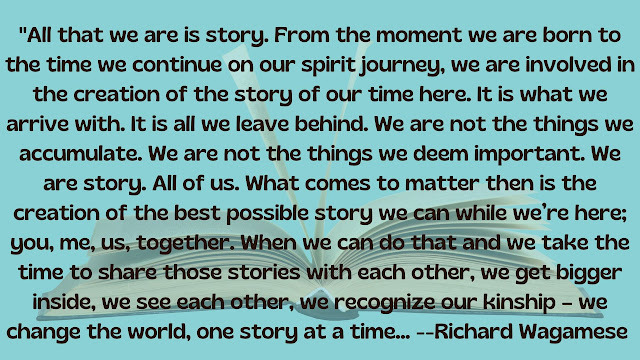
All that we are is story. From the time we are born, to the time we continue on our spirit journey, we are involved in the creation of the story of our time here. It is what we arrive with. It is all we leave behind. We are not the things we accumulate. We are not the things we deem important. We are story. All of us. What come to matter then is the creation of the best possible story we can while we're here; you, me, us, together. When we can do that, we take the time to share those stories, we get bigger on the inside, we see each other, we recognize our kinship-- we change the world, one story at a time. 
--Richard Wagamese

In the midst of busy days and numerous demands on our time and energy, it is easy to lose sight of this simple, yet powerful message. Each of us has a story, a context, that we carry with us through our day. We come into contact with numerous individuals throughout the course of our day-- at the drive-through picking up our morning coffee, at the grocery store, at the gas station on our way home from work. It's easy to fall into a familiar routine, to be weighed down by the responsibilities and pressures that bombard us. 

But I would suggest that it's equally as easy to take a moment to smile at a stranger, to hold a door open, to say thank-you, to let someone ahead of us in line. 

This holiday season, let's take a moment to see each other, to recognize our kinship, to learn each others' stories and exchange the gift of kindness and understanding. 

Wishing everyone a wonderful winter holiday! 

Wednesday, 17 October 2018

Navigating Negativity: Five Steps to Strength-Based Leadership

People don't typically don't come to me when things are going well.

This isn't a complaint. It's the reality of the life of a school administrator. We are the problem solvers, the peace keepers, the crisis responders. On any given day, I will usher crying students, angry parents and frustrated teachers across the threshold of my office. As I walk the hallways at break and lunch, I am bombarded by questions and queries, complaints and conflicts. When my email dings or my phone rings at eleven o'clock at night, it's rarely good news. 

So in the midst of what can sometimes feel like a sea of negativity, it is even more essential that I maintain a positive mindset and strength-based approach to leadership. 

I have developed the following strategies to assist me in this approach:

1. Start with relationships. Relationships form the foundation for any successful organization. Students and staff need to feel connected and cared for. As such, leaders need to take the time not only to learn the stories of those around them, but to also share their own.

2. Assume the best. Research shows that individuals will rise, or fall, based on the expectations of those around them. If we believe that students and staff can achieve great things, they will. I try to begin every conversation with a student, parent or teacher with the assumption that they want to do their best, but might need some guidance on how to make that "best" a reality. It is my job to see the potential, the capacity, for great things in every individual. 

3. Shift the focus. Education in general can be very deficit based. We tend to focus on what needs improvement rather than what is going well. As such, many conversations are focussed on identifying problems rather than finding solutions. It is important to be realistic about challenges, but it is equally important to identify and celebrate strengths. I do my best to re-frame obstacles as opportunities. I have learned to embrace challenges as an impetus for change.

4. Listen more, talk less. More often than not, individuals just need an opportunity to vent. Sometimes my most effective "problem solving" approach is to simply listen and provide a space in which they can discover their own solutions. In this way, leaders can build capacity in those around them. 

5. Keep calm. While I am sometimes the target of anger and frustration, I have learned that it is rarely about me. In my role as a school administrator, I may represent an individual's previous negative experiences rather than their current reality. I remind myself that everyone has a story, a context, and I do my best to maintain a calm and professional demeanour in the face of heightened emotions.


Friday, 5 October 2018

The Power of Your Words

On World Teacher's Day, a reminder of the impact of our words and actions in a child's life...

For sparking imaginations,
For inspiring creativity,
For igniting passions,
For shaping minds,
For all that you do,
Thank You.

YOU make a DIFFERENCE. 


Friday, 22 June 2018

Take a Moment to Celebrate

It only took a minute.

Actually, more accurately, probably about 40 seconds.

A moment to make a "good news" call to a parent who typically only gets phone calls when her son has done something wrong. In fact, I've been the person who's had to make several of those calls this year.

This boy has struggled to find his way and has made some poor choices earlier this year. Repeatedly. At one point, I didn't have much hope that he would be able to turn things around. He was on the verge of going down a road that would be very difficult to travel.

The last time I spoke to this student's mom, she was in tears in my office, accompanied by her son and an RCMP officer.

But then...something changed.

I'm not sure ultimately what made a difference- a supportive teacher, a persistent counsellor, a parent who didn't give up... I'd like to think perhaps that even I played a part.

But over the past several months, something changed.

He started coming to school. On time! I'd see him in the lounge working on homework with other students. He'd smile and say, "Hey Ms. Garr!"

So today I took a moment... A moment to call this student's mother and share with her the improvements that I've noticed and how happy I was to see the change. She paused in uncertainty. And then, I could "hear" her smile. She thanked me, saying how much she appreciated me calling. She was in tears again, but this time, it was happy tears.

Now, I'm not saying this student is perfect. He's still struggling in some classes. I know he will still have challenges and difficult choices ahead. But I took a moment to make a "good news" call to a parent, to celebrate where her son is today.

I hope it made a difference in her day. It certainly made a difference in mine.

Happy year end!


Wednesday, 30 May 2018

Today, I am a Police Officer...and Other Evidence of Success

There are many aspects of my role that I love. However, year-end as a secondary administrator means a great deal of time devoted to tasks that can take me away from time with students and staff.

In case I'm unaware of the endless hours I've spent glued to my computer working on timetabling, staffing and year end events, I am reminded by the oh so friendly "check your rings" from my Apple watch. Triggered by my uncharacteristic inertness, it alerts me that I am still able to "close my rings" if I just go for a brisk three hour walk. Unlikely.

But despite the need for me to spend a frustrating amount of time staring at a computer screen, I am still committed to devoting a good portion of my day to students. After all, that's what it's all about. Barring early morning meetings or unforeseen emergencies, I am still able to maintain my "good morning" routine of welcoming students. I am still able to make my way into a sea of students at breaks and lunch.

As I took some time at lunch today with students in our lounge area, I noticed one of the Educational Assistants holding up a chart for a student with autism. It gave him a visual reminder of what "zone" he was in. This is a student who has some severe behaviour challenges, but has made amazing progress this year.

Although this student has a very concrete representation of his ability to regulate his emotions, he's certainly not the only one who is struggling in these last few weeks of school. It's a time of anxiety and uncertainty for many: students who are worried about final marks and assessments, staff who are concerned about placements for September...
I am not immune to this whirlwind of uncertainty and unease. And so I purposively look for small examples of positivity and  success to bolster me and those around me. 

Today, I received just that from the very student that I saw today at lunch. I have seen numerous examples of his success this year. But today, he provided me with an example of my own. 

Some context...

This is a student who takes great interest in figures of authority, ranked in order of "importance" from his perspective: lifeguards, security guards, fire fighters and police officers at the top of the hierarchy. He has developed a pretty special relationship with our school RCMP liaison officer. And he provides "badges" to adults in our school community that "rank" them based on his view of them. Along with the assigning of badges, this student practices positive social interactions. And as I said, he has made incredible gains. 

For much of the year, my "rank" has been lifeguard. I knew that I had to work to build trust, to build a relationship with this student. After all, I was the "newbie". I set it as a personal goal to build trust, to move up the "ranks", and prove that I was worthy of the coveted police badge. 

Yesterday, I got fire fighter. 

And today, nine months into the school year, today I received a police badge. 

Now don't get me wrong, I may be "demoted" tomorrow, based on any number of factors. But today, I received very concrete evidence that despite being buried in tasks that don't directly seem to impact students in a meaningful way (although of course they do), I am indeed making a difference. 

And so in those moments when my owns zones of regulation may blur into something that resembles a hazy abstract piece of modern art, I will remember this day.

Today, I am a police officer. 
My police officer badge!


Sharing Our Stories

       It is "Back to School" Eve. After over 30 years in education, the feelings of excitement and apprehension are pretty famili...