Monday, 5 September 2022

Sharing Our Stories


It is "Back to School" Eve. After over 30 years in education, the feelings of excitement and apprehension are pretty familiar. It's an incredible responsibility to help support a student's journey to success. And an amazing privilege. So it is no wonder that so many of us experience this mix of emotions in the days that lead up to the start of a school year.

But this year is also a bit different for me. For the first time, I am embarking on this journey in the role of Principal. So perhaps a wee bit heavier on the apprehensive side than most years...

Although I am in a different role, my core beliefs remain the same. Relationships are foundational. Trust and transparency through the sharing of our stories is essential. 

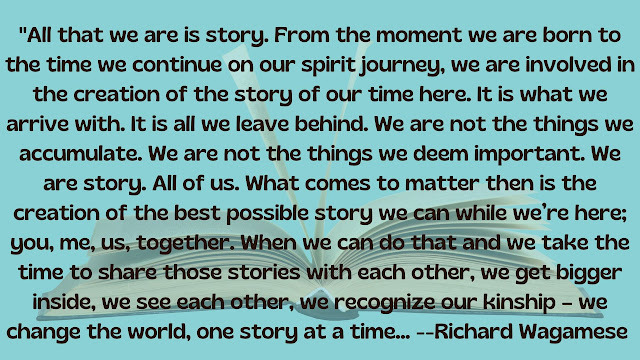
The quote by Richard Wagamese has guided my own personal journey. It is a reminder to me to take the time to learn the stories of others. If we can ensure that our students, families and staff feel connected, feel like they belong, then learning and growth will happen. 

Connections before content. 

I know there is an almost overwhelming sense of urgency as we start the school year. So much to accomplish. So many "to do" lists. I am feeling this even more now than in previous years. But  I am reminding myself to slow down, to take the time to listen. 

And I have no doubt that together, "we will change the world, one story at a time."


Friday, 11 March 2022

Gratitude for the Positives

 My last blog post was in June 2021. That is an indication of the kind of year it has been. 

Dare I say, unprecedented?

With the easing of COVID restrictions in BC, and the removal of masks on the horizon, I am finally allowing myself to see the light at the end of the tunnel. Because it's been pretty darn dark at times.

I read somewhere that the human brain likes to focus on the negative. It's our "comfy place". However with conscious effort, we can shift to a focus on the positives. This a key component of resilience.

As George Couros says, "We need to make the positive so loud that the negative becomes almost impossible to hear." I have this on a poster on the wall of my office. 

To be honest, I haven't always done a great job of this over the past two years. I haven't always been my "best self" at work, or at home. 

But fortunately, I have not gone through this journey alone. 

At home, I have a loving family who inspires and supports me, especially in those moments when I have lost faith in myself. 

At work, I have an incredible staff who have come up with creative, innovative and flexible ways to support students' academic, social and emotional growth. It has reinforced what I have always known to be true: every single individual in a school community plays a role in supporting a student's success.

So I am taking this moment to pause amidst the craziness to say a heartfelt thank you.

Thank you to our office staff who are unfailingly kind, patient and professional to every single person who walks through the doors of our school - students and adults alike. 

Thank you to our support staff who work tirelessly with students, adapting to individual needs, strengths, challenges and stories. 

Thank you to our teaching staff who have moved mountains to connect with students and families through the ever changing Covid landscape. They have adapted, pivoted, flexed and adjusted...all this with incredible empathy and compassion. 

Thank you to our custodial staff who go to great lengths to ensure that our buildings are safe and welcoming for students and staff.

Thank you to my Admin partners who share the load, share the laughs, and occasionally share some colourful language behind closed doors. 

Thank you to our district staff who do their best to understand and support our individual school contexts and needs. 

Thank you to our families who trust us with their most precious possession, their children.

And finally, thank you to our students who almost always have patiently and respectfully complied with all of our endless protocols and procedures to ensure that we have been able to keep schools open and safe. With minimal grumbling and eye rolls.

YOU make it all worthwhile.

Tuesday, 29 June 2021

The Gifts of Covid - A Year (and a bit) In Review

I would bet that when most folks look back over the past year and a half, they don't use the word "gift" in association. For a multitude of reasons, it has been hard. Understatement. 

But, I would also bet that many folks look back over the last year and a half with appreciation and gratitude for the multitude of little things that without a global pandemic might not have happened...

The *gifts of Covid. 

For me, it has been less about new understandings, and more about a greater appreciation for those things that I had already identified as essential to a successful school community. 

As we move through the last few days of this school year, here are just a few of those:

1. Change is an opportunity. 

We have been given the gift of disruption. An opportunity to pause, reflect and revisit structures, approaches, procedures and policies. 

2. Clear communication is essential.

In times of uncertainty, there is no such thing as 'over communication'. Even if the response is simply, "I don't know, but I'll find out." Repetition, transparency and consistency are all important aspects of clear communication. 

3. Everyone has a story.

Adults and children alike carry their stories with them. Understanding context takes time, trust and patience. 

4. Intention is important but/and others' perspective matters.

While we may act with the best of intentions, if these actions are not perceived as supportive/constructive/inclusive/collaborative, then that is what matters. The ability to listen, reflect and adjust accordingly is important. 

Wishing everyone a restful and safe summer. Here's to no masks and less sanitizing in September!


*With great appreciation to my colleague and friend Tina Pierik who coined this phrase!

Wednesday, 10 March 2021

School is So Much More

Here goes the understatement of the century...

The last year has been tough. During a pandemic, everything takes longer. And is more difficult. Tasks that at one time came as naturally as breathing now involve intentional, mindful, painfully slow consideration and planning. 

So it's no wonder that we are all exhausted. And impatient. And ready for it all to end. 

But in the midst of the many obstacles, there have been SO many more moments of gratitude. And appreciation. And new-found joy. In the simple things. The things we used to take for granted. 

The most profound of these moments comes from a greater appreciation for all that schools do. 

Yesterday I watched kids playing volleyball in the gym. They were distanced, the equipment had been sanitized and they were wearing masks. And it brought tears to my eyes. Because kids were laughing. And joyful. And for many, participating in something that "pre-Covid", they might not have. For these kids, it was a connection. A place to belong. A distraction from many months of trudging through protocols and procedures. 


If asked, most people might say that the primary purpose of schools is to "educate" students. But what I have come to appreciate more deeply in the past year is that our purpose is so much more. 

School is connection and belonging, safety and nourishment, stability and inspiration. 

School is so much more.


Wednesday, 28 October 2020

Learning in a Pandemic: Connections Over Content

Trauma informed education. Social-emotional learning. Empathy based instruction. These are all practices that have increased in prominence as the conversation continues around what education should look like during a pandemic. Indeed, if you were to walk into a school in most parts of BC today, things would likely look quite different. And yet, I would suggest that they don't look quite different enough.

The reality is that many of these differences are more reflective of new provincial health protocols rather than significant shifts in education. In part, I would argue that this is due to our innately human desire to "get back to normal". We crave familiar routines and structures. As such, some educators are struggling to deliver "pre-COVID" content to "post-COVID" students. Many parents are also feeling the pressure to get their children "caught up" as a result of missed time in the classroom. In both scenarios, students are the focus of this increased stress and anxiety. 

With the very best of intentions, we are essentially "punishing" students during a pandemic. 

By struggling to squeeze the same pre-COVID content into a school day that for the most part is structured significantly different, we are exhausting ourselves. And our students. And it worries me. Because with a somewhat heavy heart, I've come to realize that we're in this for the long haul. Even if a vaccine was to be introduced tomorrow, the impact of the last ten months will permeate our society for years to come. It would be an impossible task to attempt to compensate for all that we have lost. 

And so, we need to give ourselves, and those around us, "permission" to let go of some things in order to focus on those elements that are essential to a school community: relationships, connections, curiosity, exploration and a love of learning. 

My son was a member of the graduating class of 2020, otherwise known as a "Quaren-Teen". Rather than traveling the world as he had originally planned, he is working full time on an organic vegetable farm. He may or may not return to school at some point. He has no idea what he wants to do in the coming years. And I'm totally ok with that. Because he is still learning. He is still growing. We've both had to let go of our pre-COVID plans and expectations in order to make space for new plans and adjusted expectations. 

Learning during a pandemic should look different. And not just because hand sanitizer and masks feature prominently in our schools. But because we have shifted our teaching and learning to address what is truly essential for the success of our students in this new reality. 

Sunday, 13 September 2020

Managing Change - Our New COVID Reality


At my core, I am a creature of habit. I would suggest that for the most part, many educators are. We like structure and routine, predictability and patterns. Change is uncomfortable. And unsettling. It is an unknown element that fills many of us worry and stress. But I have also come to understand that in that place of uncertainty, growth and learning happens. Learning happens on the edge of understanding.

In many ways, this pandemic has forced us to re-examine long-held systems, to re-envision which aspects of our traditional structures best serve our communities. It has been an opportunity. With so much "new-ness", innovation and change is a constant. And for the most part, we have come to accept that. 

But with change, comes anxiety. It is palpable in our communities. It is real. And it can be debilitating. And so I am mindful of doing my best amidst all of this "new-ness" to also offer the security and stability of familiar routines and structures. 

The next few months will be about finding a balance. A balance between the new and the familiar. A balance between those things that must be implemented, and those things that we can take the time to examine. reflect upon and consult. 

I am in a new city, in a new district, at a new school. But like my fellow educators, one element remains the same - we will do our very best to support our students. 
No matter what. 

Sunday, 3 May 2020

Bridging the Distance in Distance Learning

When connections and relationships are essential to a successful school community, how is it possible to sustain and build upon those connections during this time of distance learning? Not only is this a challenge facing teachers, but one that school and district administrators must also consider as we strive to support our staff during challenging times.

Ideally, the ground work has already been established. The strong relationships that were founded when we had the opportunity for regular, face-to-face interactions will still exist. But even in those instances, new demands on our days might lead to some neglect of these strong ties. There is a tendency to assume that those who we feel "jut know" that we are here to support them may not need as much contact. But the overwhelming "new-ness" of our current state has a destabilizing effect on everyone.

Establishing connections with individuals who are new to our organizations is even more challenging.  As social creatures, we rely a great deal on "in-person" interactions. As such, establishing strong professional relationships via email, even video-conferencing, can be significantly more challenging.

In previous posts, I've shared what I believe to the be the essential elements of a successful school community (Five Essential Elements of a Successful School Community). I would suggest that these elements are even more essential during this time of distance learning. But with the complication of physical distance and a myriad of new obstacles, we need to be even more intentional in our approach.

Here are a few new understandings that I've come to;

1. Everything takes more time. With irregular schedules and less reliable methods of communication, I have learned to be patient, extending timelines for myself and others. Tasks that previously would have taken a few minutes, can now extend to days, even weeks. Operating on "old" timelines is unrealistic and stress invoking. We will all get there, eventually.

2. Everyone is feeling stressed and anxious. To varying degrees, each of us is operating in a new and challenging context. For many of us, we have shifted from a somewhat predictable and routine schedule to a very new reality. Our work days have likely taken on new hours. Our working environments look remarkably different. And our future is uncertain. I have learned that this constant state of stress and anxiety impacts each of us differently, and to be mindful of this in my interactions with others.

3. Relationships are more important than ever. Related to my first two points, I now "build in" time just to chat. While taking this time can be challenging with looming deadlines and numerous tasks to complete, I try to prioritize the person over the objective. Intentionally building in this time to connect and discuss topics that may be unrelated to the task at hand is ultimately more effective than trying to barge ahead with an agenda. Those few moments can provide valuable insight and understanding.
Relationships are more important than ever. 


Tuesday, 11 February 2020

Relationships Not Rules

You might not expect to hear this from a school administrator, but I don't believe in rules.

That's not to say that I don't have high expectations for students. But I don't believe that a long list of "Do's" and "Don'ts" is in the best interest of any student or school community. Students are complex. They are unique. And so when I speak with a student who is struggling, it is the relationship that I have worked to establish with that individual that guides my response, not a list of rules.

Ultimately, successful school communities are built on relationships, not rules.


Monday, 27 January 2020

"Team" is a Verb.

I was recently asked to respond to the following question:

What are you most grateful for in your current role?

I answered without hesitation.
My team.

Much has been written about teacher isolation and the need for educators to foster collaborative relationships with colleagues. Whether separated by grade level, content area or the physical layout of a school itself, isolation can lead to stagnation and burn out. There is little debate that isolation has a negative impact on teachers, and by extension, their students. 

However, I would suggest that the need for a supportive, collaborative team for administrators is of equal importance. As the role of school administrator evolves, so do the associated stressors. As such, "going it alone" is no longer a feasible, nor a professionally responsible option. 

I am incredibly fortunate in my current role that my team consists of four administrators; a principal and three vice principals. However, numbers alone do not necessarily equate to a lack of isolation. 

"Team" is a verb, not a noun. 

Creating a strong team requires intentional, focussed action. As with any relationship, it takes time to establish trust. 

In addition to formal coaching and mentoring structures, I would suggest that more informal structures are also needed to build cohesive, effective teams. But in the midst of hectic and often stressful days, how can we "build in" both formal and informal structures? 

Below are five simple strategies to help build strong teams. 

1. Share your stories. Understanding the unique context that each member of your team brings with them to work every day is absolutely necessary. Whether it's young children, aging parents or a recent divorce, each of us has external stressors that may impact our lives on a daily basis. By sharing our stories with our team, we can offer additional supports when needed. 

2. Share the load. Although each member of an admin team may have different portfolios, with distinct tasks and responsibilities, offering a helping hand goes a long way. One of my most inspiring principals would often help stack chairs alongside the custodian and vice-principals at the end of lunch. 

3. Share your food. Most administrators eat hunched over a keyboard, or snack in their car between meetings. Food should be social. Scheduling time at least once a week to sit down with your admin team to eat lunch together can be enormously beneficial, not only for physical health, but also for mental well-being. 

4. Share your learning. Whether it's sharing Professional Growth Plan goals, or attending workshops together, learning alongside your team can help to inspire and sustain ongoing growth, both for ourselves and for our team members. 

5. Share (and celebrate) your successes. Sometimes we forget to acknowledge the great work of those closest to us. Along with "high five-ing" students, and giving kudos to exceptional staff, it's important to do the same for members of our team. A simple thank-you, a card (or a bottle of wine) goes a long way!

Ultimately, taking care of our team allows us to take care of our school communities and organizations. Leadership is a team sport. 


Tuesday, 4 June 2019

Five Essential Elements of a Successful School Community


While it's true that each school context is unique and comprised of diverse needs, challenges and strengths, I would suggest that there are certain elements that form the foundation of all successful school communities.  These are what I identify as the "non-negotiables".

1. A clear, consistent vision. 

It is impossible to move forward if we don't know where we're going. 

A clear "road map" that provides a community with a sense of direction is essential. Finding a common purpose should be a collaborative process, and ultimately clearly communicating that vision of the future is the next essential step in any change process. In the midst of what what might be perceived to be competing agendas and initiatives, it is important that we are able to identify and articulate a common vision. We need to be able to "connect the dots" for staff and students, giving purpose and focus to individual initiatives under the larger umbrella of that shared vision.

2. Relationships as a foundation. 

Students and staff need to feel connected and cared for.

In her article "If You Want Students to Learn, They Need to Feel They Belong", author Tricia Taylor highlights the importance of relationships in creating a sense of belonging in school communities.

"Cognitive scientists explain that belonging is important because when we belong, we feel safe, and a safe brain is ready to learn. On the other hand, when the amygdala, the part of the brain responsible for regulating stress, feels threatened or is on high alert, information is then blocked from freely entering areas of higher cognitive memory consolidation and storage. A safe brain allows for a growth mindset and better executive function, which means being better able to make mistakes/take academic risks; having a higher level of self-efficacy (more willing to set higher goals, etc.); and practising more self-control, which results in less conflict. We are also better able to persevere and think hard about tasks."  


3. An environment where both students and staff are encouraged to learn and take risks. 

If students are the only ones who are learning, that's a problem.

We need to model the same curiosity and desire to learn that we hope to instil in our students. That means taking the time both individually and as a staff to identify potential areas of growth.  In The Innovator's Mindset, George Couros talks about the need to "embrace" the "messiness" of learning. By modelling a willingness to take risks and extend our own learning, we create a culture that sees "not knowing" as an opportunity rather than as a deficit. This is a powerful example for our students.

4. A culture of collaboration and trust. 

We're all in this together.

Ultimately, we all have the same goal- to support the social, emotional and academic success of our students. An impossible feat if we attempt it on our own. But collectively, we can provide the myriad of supports and opportunities that are necessary to meet the needs of a diverse student population. This means carving out the time to connect with colleagues, families and community organizations. The success of our students is a shared responsibility. 

5. A focus on joy and positivity. 

This might seem naive to some, but in a system that tends to be more focussed on what needs to be fixed, rather than what is going well, it's important to take the time to be joyful, and celebrate our successes!

In his book, Embracing a Culture of Joy, Dean Shareski writes the following:

"Doing joyful things might be the most important work we do. And when leadership in particular makes it clear that joy for joy's sake is important, then culture begins to change. Maybe we can be better, more humane, more just and more joyful than the real world. What a great lesson and model for our students."

The reality is that there is no one "right answer" when it comes to identifying the elements a successful school community. But I would suggest that it is essential to have the conversation. What do your parents, your students, your staff identify as their "non-negotiables"?


Monday, 11 March 2019

"Family and School Should Walk Together"


I was given the gift of a new perspective.

After over 20 years in education, as an educational assistant, teacher, and now school administrator (not including my own experiences as a "less than successful" student), I thought I had a pretty good sense of the education system - both the benefits and the challenges.

But this past week, through conversations with two families who are new to Canada, I gained a deeper understanding, and an even deeper sense of responsibility. 

In one conversation, a parent was looking for ways to connect her son to the school community. An ELL student who was older than some of his classmates, he was struggling to find a place to belong. An energetic and outgoing student in his home country of Brazil, the parent was beginning to see her son withdraw, and was understandably worried. 

I assured her that there were opportunities for her son, both in the classroom and through extra-curricular clubs and sports. As we talked, she shared with me some of his interests and together, we brainstormed ways to connect him to various groups within the school. I then met with her son to get a sense of how he was feelings and what he envisioned for himself. I assured both the student and the parent that I would continue to follow up and check in regularly to see how the plan that we'd created was unfolding. 

Ultimately, I did what any school administrator would do. As a vice principal, and a mom of a teenaged boy myself, I try to see every student through the eyes of a concerned parent. I treat them how I want my own son to be treated.

In a follow up email, the mother expressed her gratitude and her trust in the decisions that we made and founded that trust in the belief that "the family and school should walk together". This phrase stuck me. I was touched, and somewhat overwhelmed, by the trust she placed in the school. Not only did she expect that I would do the best for her child, it was an integral belief based on her perspective on the Canadian education system. To a large extent, it was why her family moved here. 

The second conversation was also with a family who was new to Canada. This time, both the mother and father came to my office. In the same way, they sat with me and shared their concerns for their son. Having moved numerous times over the past several years, back and forth from Saudia Arabia, the son was experiencing significant stress and anxiety. He began to avoid school, not because it was an unpleasant place for him, but because he was needing the comfort of his family home. Both parents shared heartfelt worries and hopes for their son. Through several conversations, I learned more about their family, their goals and their struggles. Again, the Canadian education system was a motivator in their move. And again, they expressed their trust and faith in me to do my best for their son. 

The irony is not lost on me that as someone who has spent the majority of their life either as a student or as an educator, it took the perspective of individuals who are new to this system to remind me of the integral role of schools. Not only are we supporting the success of individual students, we are also sometimes a vessel for the hopes and dreams of entire families. 

It was an incredible reminder that, "family and school should walk together" to support our students.


Wednesday, 19 December 2018

The Gift of Understanding


All that we are is story. From the time we are born, to the time we continue on our spirit journey, we are involved in the creation of the story of our time here. It is what we arrive with. It is all we leave behind. We are not the things we accumulate. We are not the things we deem important. We are story. All of us. What come to matter then is the creation of the best possible story we can while we're here; you, me, us, together. When we can do that, we take the time to share those stories, we get bigger on the inside, we see each other, we recognize our kinship-- we change the world, one story at a time. 
--Richard Wagamese

In the midst of busy days and numerous demands on our time and energy, it is easy to lose sight of this simple, yet powerful message. Each of us has a story, a context, that we carry with us through our day. We come into contact with numerous individuals throughout the course of our day-- at the drive-through picking up our morning coffee, at the grocery store, at the gas station on our way home from work. It's easy to fall into a familiar routine, to be weighed down by the responsibilities and pressures that bombard us. 

But I would suggest that it's equally as easy to take a moment to smile at a stranger, to hold a door open, to say thank-you, to let someone ahead of us in line. 

This holiday season, let's take a moment to see each other, to recognize our kinship, to learn each others' stories and exchange the gift of kindness and understanding. 

Wishing everyone a wonderful winter holiday! 

Wednesday, 17 October 2018

Navigating Negativity: Five Steps to Strength-Based Leadership

People don't typically don't come to me when things are going well.

This isn't a complaint. It's the reality of the life of a school administrator. We are the problem solvers, the peace keepers, the crisis responders. On any given day, I will usher crying students, angry parents and frustrated teachers across the threshold of my office. As I walk the hallways at break and lunch, I am bombarded by questions and queries, complaints and conflicts. When my email dings or my phone rings at eleven o'clock at night, it's rarely good news. 

So in the midst of what can sometimes feel like a sea of negativity, it is even more essential that I maintain a positive mindset and strength-based approach to leadership. 

I have developed the following strategies to assist me in this approach:

1. Start with relationships. Relationships form the foundation for any successful organization. Students and staff need to feel connected and cared for. As such, leaders need to take the time not only to learn the stories of those around them, but to also share their own.

2. Assume the best. Research shows that individuals will rise, or fall, based on the expectations of those around them. If we believe that students and staff can achieve great things, they will. I try to begin every conversation with a student, parent or teacher with the assumption that they want to do their best, but might need some guidance on how to make that "best" a reality. It is my job to see the potential, the capacity, for great things in every individual. 

3. Shift the focus. Education in general can be very deficit based. We tend to focus on what needs improvement rather than what is going well. As such, many conversations are focussed on identifying problems rather than finding solutions. It is important to be realistic about challenges, but it is equally important to identify and celebrate strengths. I do my best to re-frame obstacles as opportunities. I have learned to embrace challenges as an impetus for change.

4. Listen more, talk less. More often than not, individuals just need an opportunity to vent. Sometimes my most effective "problem solving" approach is to simply listen and provide a space in which they can discover their own solutions. In this way, leaders can build capacity in those around them. 

5. Keep calm. While I am sometimes the target of anger and frustration, I have learned that it is rarely about me. In my role as a school administrator, I may represent an individual's previous negative experiences rather than their current reality. I remind myself that everyone has a story, a context, and I do my best to maintain a calm and professional demeanour in the face of heightened emotions.


Friday, 5 October 2018

The Power of Your Words

On World Teacher's Day, a reminder of the impact of our words and actions in a child's life...

For sparking imaginations,
For inspiring creativity,
For igniting passions,
For shaping minds,
For all that you do,
Thank You.

YOU make a DIFFERENCE. 


Friday, 22 June 2018

Take a Moment to Celebrate

It only took a minute.

Actually, more accurately, probably about 40 seconds.

A moment to make a "good news" call to a parent who typically only gets phone calls when her son has done something wrong. In fact, I've been the person who's had to make several of those calls this year.

This boy has struggled to find his way and has made some poor choices earlier this year. Repeatedly. At one point, I didn't have much hope that he would be able to turn things around. He was on the verge of going down a road that would be very difficult to travel.

The last time I spoke to this student's mom, she was in tears in my office, accompanied by her son and an RCMP officer.

But then...something changed.

I'm not sure ultimately what made a difference- a supportive teacher, a persistent counsellor, a parent who didn't give up... I'd like to think perhaps that even I played a part.

But over the past several months, something changed.

He started coming to school. On time! I'd see him in the lounge working on homework with other students. He'd smile and say, "Hey Ms. Garr!"

So today I took a moment... A moment to call this student's mother and share with her the improvements that I've noticed and how happy I was to see the change. She paused in uncertainty. And then, I could "hear" her smile. She thanked me, saying how much she appreciated me calling. She was in tears again, but this time, it was happy tears.

Now, I'm not saying this student is perfect. He's still struggling in some classes. I know he will still have challenges and difficult choices ahead. But I took a moment to make a "good news" call to a parent, to celebrate where her son is today.

I hope it made a difference in her day. It certainly made a difference in mine.

Happy year end!


Wednesday, 30 May 2018

Today, I am a Police Officer...and Other Evidence of Success

There are many aspects of my role that I love. However, year-end as a secondary administrator means a great deal of time devoted to tasks that can take me away from time with students and staff.

In case I'm unaware of the endless hours I've spent glued to my computer working on timetabling, staffing and year end events, I am reminded by the oh so friendly "check your rings" from my Apple watch. Triggered by my uncharacteristic inertness, it alerts me that I am still able to "close my rings" if I just go for a brisk three hour walk. Unlikely.

But despite the need for me to spend a frustrating amount of time staring at a computer screen, I am still committed to devoting a good portion of my day to students. After all, that's what it's all about. Barring early morning meetings or unforeseen emergencies, I am still able to maintain my "good morning" routine of welcoming students. I am still able to make my way into a sea of students at breaks and lunch.

As I took some time at lunch today with students in our lounge area, I noticed one of the Educational Assistants holding up a chart for a student with autism. It gave him a visual reminder of what "zone" he was in. This is a student who has some severe behaviour challenges, but has made amazing progress this year.

Although this student has a very concrete representation of his ability to regulate his emotions, he's certainly not the only one who is struggling in these last few weeks of school. It's a time of anxiety and uncertainty for many: students who are worried about final marks and assessments, staff who are concerned about placements for September...
I am not immune to this whirlwind of uncertainty and unease. And so I purposively look for small examples of positivity and  success to bolster me and those around me. 

Today, I received just that from the very student that I saw today at lunch. I have seen numerous examples of his success this year. But today, he provided me with an example of my own. 

Some context...

This is a student who takes great interest in figures of authority, ranked in order of "importance" from his perspective: lifeguards, security guards, fire fighters and police officers at the top of the hierarchy. He has developed a pretty special relationship with our school RCMP liaison officer. And he provides "badges" to adults in our school community that "rank" them based on his view of them. Along with the assigning of badges, this student practices positive social interactions. And as I said, he has made incredible gains. 

For much of the year, my "rank" has been lifeguard. I knew that I had to work to build trust, to build a relationship with this student. After all, I was the "newbie". I set it as a personal goal to build trust, to move up the "ranks", and prove that I was worthy of the coveted police badge. 

Yesterday, I got fire fighter. 

And today, nine months into the school year, today I received a police badge. 

Now don't get me wrong, I may be "demoted" tomorrow, based on any number of factors. But today, I received very concrete evidence that despite being buried in tasks that don't directly seem to impact students in a meaningful way (although of course they do), I am indeed making a difference. 

And so in those moments when my owns zones of regulation may blur into something that resembles a hazy abstract piece of modern art, I will remember this day.

Today, I am a police officer. 
My police officer badge!


Tuesday, 24 April 2018

"Re-Purposing" School Structures

"Innovative" is not synonymous with "new".

I had the opportunity to meet with admin colleagues today, in part to continue a conversation about  "re-imagining" teaching and learning in a secondary setting. Previous sessions have included visits to secondary sites in other districts to explore frameworks that extend beyond the "traditional".

In many cases, these are schools that are viewed as incredibly innovative and progressive. And indeed, they are.

But some of the most "innovative" ideas that I heard from colleagues today were not about introducing new frameworks or structures- they were about "re-purposing" existing frameworks.

One Admin team spoke about a process they undertook to re-examine the model of sustained silent reading. Over the years, the school community had evolved in ways that made the traditional model obsolete. However, despite their best efforts, teachers were reluctant to make what was viewed as a signifiant change and ultimately the initiative was voted down by the staff.

But rather than giving up, the team persisted, purposively and intentionally shifting their focus, identifying obstacles and continuing to work with staff to come up with a structure that incorporated elements of the "old", but also introduced some "new" components. They "re-purposed" the model of sustained silent reading. Not entirely new, but most definitely innovative.

A similar "re-purposing" has been occurring at my own school in connection to our Advisory model. A structure that is designed to build meaningful and sustained relationships between students and teachers, over the years some staff and students had lost sight of it's original purpose and intent. Among other indicators, we noticed that students were increasingly late to class, offering the excuse of "it's just Advisory" when they were questioned in the halls. This signalled a loss of purpose and intention in the Advisory classes themselves.

Rather than calling a halt to the Advisory model, we decided to meet with staff and students to explore what aspects of the model they valued, and what aspects they felt were less essential. As a school community, once we had decided on those elements we valued, we then looked at ways to provide additional supports. Gradually, we are "re-purposing" our traditional model of Advisory into a model that is "custom built" to serve the needs of our evolving school community. Again, not new, but I would argue, innovative.

Limited time and resources can be a significant barrier to the successful implementation of new initiatives and structures. But by re-examing and "re-purposing" existing structures, meaningful and sustained innovation is absolutely achievable.


Friday, 9 March 2018

Everybody Has a Mountain to Climb

It's a remarkable thing when one's passions intertwine in synergistic harmony...

Some of you may know that in my “free time”, I love to hike and even summit the occasional mountain. For me, hiking is a kind of moving meditation, an often solitary excursion that affords me the time to reflect and decompress. 

Summiting a mountain is an extremely humbling experience. It allows me to push my limits, both physically and mentally. The ability to persevere in challenging circumstances serves me well in other areas of my life as well. I have experienced the triumph of pushing past pain and discomfort, of taking just one more step when it seems impossible. I use this analogy when I'm speaking to students who are struggling with seemingly insurmountable obstacles. I strive to help them to see their potential, their infinite possibilities. I try to help them to "climb their mountain" and experience that same triumphant feeling of success and accomplishment. 

In my role, sadly I see many children and families who are navigating incredible challenges. The stress and heartache of having a child who is sick and in need of hospitalization can be debilitating for families. As a vice-principal, I have often wished that I could do more to provide support to these families. 

And so, when the opportunity presented itself to combine two of my passions- hiking and helping children, I jumped at it. 

In August, 2018 I will be leaving on an expedition with an amazing group of people from an organization called Summits of Hope. Our team will be travelling to Peru, reaching altitudes of 4200 metres on our climb to Machu Picchu. Although the climb itself will be incredible, it’s even more special in that our goal is to raise money for children at BC Children’s Hospital.

I will be climbing over four days, ascending with a team of thirteen other team members. The funds that we raise will support cancer research, patient care, education, and advocacy for BC Children’s Hospital Foundation, and the Summits of Hope Endowment fund. 

As a member of the Summits of Hope team, I have committed to raising $5000. The prospect of that is somehow more daunting than the climb itself, but I plan to approach it as I do most things in my life- with faith, hope and a great deal of stubborn determination. And like most things in my life, I won't be able to do it on my own. I will need the help and support of friends, family and my team members. 

I hope that you will follow me on this journey. I know that it will not be an easy one- neither the fundraising nor the climb itself. But I also know that there are children whose "mountains" are so much more difficult to climb. In the end, all we can do is put one foot in front of the other, with faith, hope and a great deal of stubborn determination...

Please click on the link to my climber profile page if you would like to donate:
http://www.summitsofhope.com/climberProfile/sarah_garr


Sharing Our Stories

       It is "Back to School" Eve. After over 30 years in education, the feelings of excitement and apprehension are pretty famili...